Sunday, October 18, 2020

Are You Zapping the Fun from Your Historical Fiction?

I once picked up a historical fiction novel that imagined the life of a wife a certain man in ancient history. The man in question had fascinated me since early childhood and I've often wondered about his wife, whose name in lost to time. I was thrilled to see that someone had finally given her a story of her own and looked forward to seeing their love story and adventures together. 

That wasn't what I got. Instead, I was treated to several chapters detailing her interactions with her sisters  and details of the day-to-day household chores women did in 600 B.C. Her husband didn't show up until several chapters in. I suppose you could argue that I was seeing a more feminine side of history, but I felt like I was watching women do chores while the menfolk were off having adventures. There was no reason, absolutely none, to care about this historical woman except her connection to her husband. He needed to get on screen sooner. 

Around the same time, I read a historical fiction novel about a famous abolitionist. I assumed the story would be set against the dawn of the Civil War and involve her interacting with a number of black characters yearning for freedom. Instead, the novel took place many years before the war and black people only appeared twice, never as named characters. There were a few discussions of race among white characters, but that was it. The vast majority of the story consisted of our heroine sweeping her kitchen floor, polishing the stove, and racing against time to get dinner on the table before her husband came home. Instead of the nation-wide drama of war, I watched the small-scale drama of her disagreeing with her husband, sister, and mother-in-law over topics that usually had nothing to do with slavery. I began to feel like I was reading about some other, far more nineteenth century ordinary woman with the same name as this abolitionist.


That feeling came back early this summer, when I read a novel about Annie Oakley. Annie was renowned as a sharpshooter. She could shoot a cigar from her husband's lips and split a playing card held sideways with a well-aimed bullet. But very little of that appeared in the story. After several hundreds of pages into the book, Annie had only fired a gun three times. I began to feel like I was reading about some other girl named Annie and not our Miss Oakley. I don't want to read about sharpshooters who don't shoot, abolitionist who don't abolish, and historical wives who don't spend page time with their famous husbands. 

I've also seen historical fiction bogged down by accuracy. Writers want to show off their work and have their princesses staying in the right castle at the right time in the year of our Lord fifteen hundred and whatever, rather than putting her in the castle where all the action is. An intrepid reader may eventually care about accuracy if they do their own research, but most just want a good show. As a young reader, I was always saddened with a historical fiction book about women's suffrage turned into a young character whose life was consumed by school and friends while her mother was off winning rights, or a Salem Witch Trials book where the protagonist was tangential to the trials instead of being an accuser. 

Remember to let your characters do the job readers hired them to do-shooting, abolishing,  and voyaging with their husbands to discover new and ancient lands. 

Tuesday, August 25, 2020

One Tale to End All Tales?


When I was fifteen, I wrote my first novel and I was determined it should be revolutionary. It wouldn’t employ a single trope or similarity to another work of fiction. Before long, this proved tricky and I stayed after class one day to ask my English teacher if anyone could create a truly original story. She responded by sketching a Hero’s Journey monomyth diagram on the board. That is how, a few weeks ahead of my entire class, I learned that the Hero’s Journey was the one tale to rule them all.

Until college. Four years later, again a sophomore, I took a literary theory class where the course text was a book of essays and autobiographical fiction by the Native American writer Zitkala-Sa. While analyzing it in an essay, I once more broke revolutionary ground when I realized Zitkala-Sa’s stories didn’t fit in Joseph Campbell’s monomyth model. Why, this was because Joseph Campbell, the great white male, had neglected to take women and native people’s stories into play. Oh, the injustice of it all! And so I set out to write a semester long research paper about how the Hero’s Journey in all its colonialist glory had overlooked marginalized storytellers.

Until the night before my paper was due. I’d been going off a Hero’s Journey diagram I’d found on the first page of google and assumed, because the website mention Campbell’s book The Hero with A Thousand Faces, that it was all accurate to the book. With my paper all polished and peer edited and ready for submission, I decided I’d check out the book itself, find a few quotes to throw in, and call it good. But when I flipped to the index, I found the names of several Native American tribes listed. Campbell had taken Native American myths into account.

I overhauled my entire paper overnight.

Two years later, I took a myths, legends, and folktales class and discovered that there are myths, legends, and folktales. Campbell’s myth model was only ever intended for myths. If you want to analyze a fairy tale, you don’t go to Campbell, you use Proppian analysis. Though Vladimir Propp tracked some elements common with Hero’s Journey stories (heroes, villainy, overcoming), they’re more tailored to fairy tales.

Proppian analysis starts with a family member absenting themselves from the home. Beauty’s father leaves for a journey, Hansel and Gretel are led to the woods, Cinderella’s mother is dead. It ends with a wedding and ascension to the throne. This can either be literal (Snow White marries her prince) or more figurative (Dorothy and her traveling companions are rewarded). Fairy tales feature a donor character, like Cinderella’s godmother or the dead Wicked Witch of the East, who grant the hero magical a magic talisman or assistance.

Last night I watched a stage production of Mary Poppins. Neither Miss Poppins nor the kids have a hero’s journey. The kids have a problem (distant parents) but don’t take action to fix it on their own. Mary Poppins takes action but she doesn’t have a problem. Fixing the Banks family doesn’t give her anything. At no point in the story is she really threatened or endangered. This bugged me for a while until I realized Proppian analysis is probably a better fit. Suddenly, this story follows the rules. Michael and Jane absent themselves to play in the park and their parents are emotionally absent. Mary Poppins functions as their donor. A wedding is the happy unification of a family and that’s exactly what happens to the Bankses at the end. 

Proppian analysis is the wrong choice for non-fairy tale stories, like YA contemporary novels. Popular author Sarah Dessen’s YA contemporary books usually feature a teenage girl on summer break. She has a job, family issues, friends, and, eventually, a boyfriend. But she’s not locked in battle with an evil overlord or witch. Some YA novels might include triumph over a sports rival, school bully, or an opponent in a class election, but  in many of them, like Dessen's, the end result is something like "the shy heroine learns to have confidence." 

YA contemporaries attempt to model real life more than mystery books do. In real life, a friend could be killed in a hit and run accident and your journey is one of grieving and healing. In a mystery novel, you track that sucker down. There are as many ways to understand stories as there are kinds of stories. Zitkala-Sa’s stories didn’t match Campbell’s pattern because she was writing biography, not because Campbell was some kind of racist. Myths don’t read like fairy tales, fairy tales don’t read like biographies, biographies don’t read like YA contemporaries, and contemporaries don't read like mysteries. The more you study different plot structures, the more you familiarize yourself with the breadth of different genres and learn new ways to frame your character's journey. 


Friday, August 14, 2020

Why Effie Trinket is the Best Character Name Ever

 The Hunger Games trilogy offers a spread of aptly-named characters. Katniss is  an edible plant with arrow-shaped leaves. Katniss Everdeen is an archer who knows how to survive in the wild. Katniss are useful plants, but not pretty ones. Evening Primroses are a delicate, prettier plant with medicinal properties. Her sister Prim is a delicate, pretty girl who wants to be a doctor. Peeta (pita) is a baker. Panem echoes ancient Roman civilizations in many ways and several Capitol officials have Roman names. 
Accessories | Mockingjay Pin The Hunger Games | Poshmark
My favorite name is District 12’s Madge Undersee, Katniss’s friend who gives her mockingjay pin. This name is fun to unpack. Madge gives her the badge and M for Mockinjay. Her last name comes from her father, who, as mayor of District 12, is supposed to oversee everything. But since he and his family let Katniss get away with poaching, it could be said he undersees everything.
Character Spotlight: Effie Trinket - YouTube
Effie Trinket’s name gives us even more to unpack than Madge’s. First, let’s look at her first name. I always imagined Effie was a nickname for Frances. A google search tells me it’s short for Euphemia-a Greek name for well-spoken. But never mind meaning or origin. All that matters is that Euphemia is an old-fashioned name no modern woman would ever saddle her child with ever. There’s something beautiful about it, but it’s a stuffy, antique kind of beautiful. Euphemia sounds like a Victorian lady of wealth, influence, and reputation. Additionally, it puts me in mind of the word euphemism-a polite term for something dreadful.
But Suzanne Collins doesn’t call her Euphemia Trinket. She’s Effie. “Effie” sounds to me like Euphemia or her parents looked at this name and said, “How do I make this cute? How do I make this trendy?” and the resulting Effie was the best they could come up with. I can’t imagine any modern parents calling their daughter Effie, but the name might work for a poodle. Effie, as a whole, sounds like an older, wealthy lady trying (and failing) to be stylish.
H&D 25 Style Jewelry Trinket Box Hinged Metal Enameled Figurines ...
Her last name, Trinket, is a real word. Trinkets are jewelry of knickknacks, sometimes expensive and never useful. Decorative. Showy. Not a weapon you’d fear and not a tool you’d go to for help. Trinkets are there to sit still and look pretty. The site MyHeritage tells me it is, in fact, used as a surname in our world, but unless you have a friend by this name, you’ll probably think jewelry before people.
Effie Trinket - PEACOCK-LIKE PERFECTION A myriad of bright colors compete to take center stage in this outfit from the first installment. From her lime green wig to her bright makeup, which pops thanks to a hot pink pout, this is one of Effie's standout looks
Now, who is our woman? She’s a resident of the Capitol, which makes her wealthy. Her job as Reaping announcer and pre-Games escort puts her in the public eye, but she’s a pseudo-authority rather than an actual one. She selects contestants for the Hunger Games but can’t be held actively accountable for their deaths. Katniss doesn’t feel the same disdain for her as she does Capitol politicians and gamemakers. Unlike Cinna, Katniss’s stylist, and mentor Haymitch, she’s useless in terms of tactical game preparation, image control, and outside assistance. Her role is to accompany rather than coach. Her hair, makeup, outfits, and accessories aim for the height of fashion but hit a ghastly kind of flamboyance. And overall, she’s a walking euphemism. She’s the reader or viewer’s first introduction to the games, a fight to the death couched inside the glamour of reality television. She knows Katniss is slated to die, but perkily downplays every pre-game milestone as “a big, big day.”
Overall, Effie Trinket carries with it the airs of:
Wealth
Influence
Triviality
Glamour
Tackiness
Old-fashionedness
Sugarcoating

Try following this pattern to create a name for a similar character. Let’s start with the name Frances. We’ll bypass the common name Fran the same way Suzanne Collins doesn’t pull the ordinary Mia out of Euphemia. If we go to the end of Frances instead, we could turn it into Sissy, a weak woman who could be cute but certainly isn't useful in a fight. Now let’s brainstorm words similar to Trinket:
Treasure
Antique
Jewelry
Bauble
Decor
Knickknack
My favorite from this list is Bauble. If we change the spelling, that gives us bobble. Bobbleheads are bouncy, entertaining, decorative, and useless. Sissy Bobble sounds like a silly, useless sort of woman.

Writing prompt: Imagine a character who is Effie's opposite in every way-powerful, dangerous, modern, youthful, and sloppily dressed. Now, give her a name. 

Wednesday, August 5, 2020

Everything Wrong with Harry Potter's Astronomy Class

The Harry Potter books are full of school scenes where Harry brews potions, learns to fly, and practices spells he'll use against Dementors and Death Eaters. The one class that never seems to be important is astronomy. The classroom itself, the Astronomy Tower, serves as a location for three memorable moments. Harry, Ron, and Hermione bring Norbert there for Charlie's friends to pick up in the third book, watch Hagrid arrest in the fifth book, and, most memorably of all, the Astronomy Tower is the setting of Dumbledore's death. But though the class setting makes it a convenient location for Harry to get a bird's eye view or clandestine rendezvous, the actual class taught there isn't worth the fuss. The very existence of this class begs questions about the practicality of the Hogwarts curriculum and what it means for Harry's daily life.

This Class Meets at Midnight
In the first book, it's mentioned that Harry's astronomy class is scheduled every Wednesday at midnight. In Harry's fifth year, he has an astronomy final scheduled for 11 o' clock at night. Sure, it makes sense that a class requiring stars and darkness would meet in the middle of the night. But, what does this mean for their school schedule? A bunch of eleven-year-olds are getting back from class at 1:00 a.m. at the earliest, and then they have to wake up and eat breakfast the same time as the rest of the school. I can only hope they don't have any morning classes scheduled the days after that so they can go back to their dormitories and nap.
Holding class at night means it must be totally normal for students to walk around the castle at midnight. Harry never runs into astronomy students when he's traipsing around the castle in his invisibility cloak. Granted, they could be only hanging out in the Astronomy Tower and whatever hallways connect that tower to the common rooms. But if it's normal for students to walk around the castle at night, that begs the question of why Harry has to do so clandestinely. Couldn't he just tell Filch he's on his way back from astronomy?

They Only Ever Learn Jupiter
From the Harry Potter wiki:
Toward the end of the (first) year, Hermione was quizzing Ron on Astronomy. Their studying included using a map of Jupiter. It was noted that the studies on Jupiter continued into later years, when Harry tried to learn the names of Jupiter's moons in his fifth year of study at Hogwarts. 

Their fifth year exam has a section on Jupiter too. There are a couple of times throughout the series where they're filling out star charts, but the only planet they study is Jupiter. Yes, yes, I know there are more stars than planets, but planets are closer and you'd expect them to come up once in a while. Jupiter must be fascinating if they can study it for five years without moving on in their education. 


They Will Never Use This
Unlike real high school, a lot of what Hogwarts kids learn in required classes is directly applicable to their real lives. Harry takes Potions; he learns how to brew polyjuice. Harry takes Defense Against the Dark Arts; he learns expelliarmus for when he's fighting Voldemort. Some classes are less useful. McGonagall is a dear, but I can't think of a time when Harry used Transfiguration outside of class. Most Transfiguration spells are ridiculously specific, like turning a teapot into a tortoise. But there are still situations where a wizard might find themselves in possession of too many teapots and not enough tortoises. Astronomy is entirely useless.
It's Not One of the Useless Electives
In her third year, Hermione enrolls in a great number of fluff classes. Tell me, when did she ever use arithmancy outside of class? Arithmancy, Ancient Runes, Divination, Muggle Studies, and Care of Magical Creatures are electives because they aren't all that important, though the last two are far more applicable than the first three. Seriously, wizards are so ignorant of Muggle society that they can't dress themselves. Muggle Studies should be a required class. Since Hogwarts has other trivial classes, Astronomy wouldn't stand out so much, except Astronomy is a required class and Arithmancy is not.
 
If they learn this, why not math?
Since astronomy has no magical value, it's possible that they're taught it as science, not magic. My high school had an astronomy class, too. But if they're allowed to study science, why not math? Why not English? These poor professors are grading seventh years' essays written by students who weren't taught writing past age eleven. Surely astronomy can't be the only normal subject they allowed into the curriculum. 


They Will NEVER Use This
Most classes at Hogwarts are about spells (Charms, Transfiguration, DADA). Potions and Herbology deal with substances that could save a person's life. What's the application for astronomy? You can't mix drops of Jupiter into Polyjuice potion. There is no mention of spells that can only be cast when Jupiter is in the proper alignment. Harry never calculates star positions to stop a dementor. The only area of magic in which stars might come in handy is divination, and that's its own class. 


Tuesday, February 21, 2017

My First Day at Hogwarts

On my first day of college, I opened  my schedule and found out my first class took place in four different rooms. One of them was a Friday-only lab, so that was a small comfort. But how could I manage to be in three places at once? At least the room numbers were close to one another. Maybe these were adjacent rooms, with nice sliding walls, and finding one meant I’d find them all.
After wandering around the basement for a while, I located Room B092. I thought, “Well, this is it! I’m officially a college girl!” I held my head high, adjusted my backpack, and pushed open the door.
I’d expected people. The room held a chair, a table, a piano, three normal walls, and the back wall, which was curved. Curved, and moving.
I shut the door and considered my options. Either I was still in seventh grade and having one of those nightmares where you’re an adult and nothing makes sense. In that case, I should try and wake up. Or, I’d arrived at a place I’d dreamt of long before seventh grade.
BYU was Hogwarts.
If that were the case, I was so changing my major from English to Defense Against the Dark Arts.
I wandered around the corner and found another one of the rooms on my class list. This time, when I opened the door, I was assured that BYU was a Muggle school.
The main classroom was an auditorium. At the back, there were merry-go-round sections with additional seats on slowly rotating platforms. I understood now. For large lecture classes, B092 served as overflow for the auditorium. When it wasn’t needed, it could turn around and provide seating for a smaller class.
It seemed a lot less practical than a simple sliding wall, but I decided to roll with it. This was how college people went to class! I decided to show the room I wasn’t afraid by walking right over the moving section.
I kept my eyes up, as if I went to class like this every day and didn’t even notice the ground moving under my feet anymore. But the instant I set foot on the platform, it froze.
The guy at the control panel glared at me. “It doesn’t move when there’s people on it.”
“Oh. Okay.” I knew that, sure.

I sat down in one of the non-moving rows and avoided the merry-go-round seating for months. Next semester, I had a class in the smaller room behind the auditorium, and we had to sit around waiting before each class for our chairs to show up. I always wondered why they built this expensive rotating platform when they could’ve just built a wall of sliding panels. 
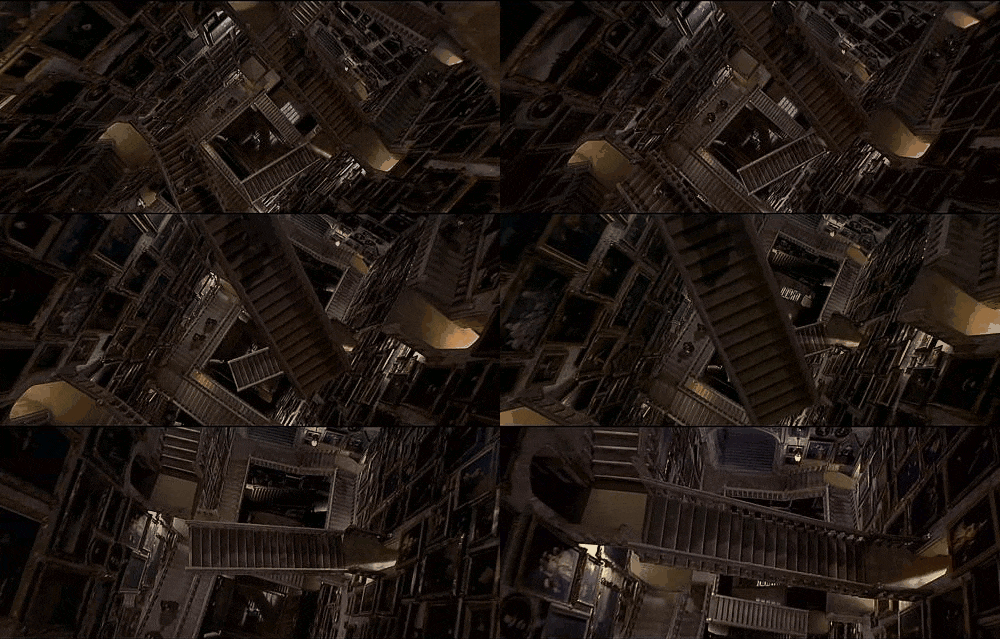
Image result for harry potter stairs gif
Image result for harry potter gif

Tuesday, December 29, 2015

Are Love Triangles All that Bad?


In the middle of finals week, I bought the third book in a series I like. I couldn’t remember how many books were in the series as a whole, so I looked up the fourth one on goodreads. That was a mistake. The very first sentence of the fourth book description said the villains of the third book killed “the girl he loved”. Well, there goes the entire story. In the first two books, the hero only had one love interest, so it had to be her who died at the end of the third book. 
Then I actually started reading the book. To my surprise, the hero got a new girlfriend in this book. That simultaneously gave me hope and made me nervous. I already knew “the girl he loved” would die by the end of this story. But who was she? Did using the phrase “the girl he loved” instead of “both his girlfriends” imply that one of them would live?
I had to know. Even though I was in the exam trenches, I devoured that book. I have five chapters left. Girl B just died and Girl A is heading the same way-but Hero still has a chance to save her. Is she going to make it?
Love triangles have received a lot of negative criticism in YA over the last several years. I've seen positive reviews praise a book for simply not having one. I once came across a "Love Triangle Free Zone" web badge on a review blog. Recently I saw an Internet Person claim that love triangles are unrealistic because “I’ve never been in one and I don’t know anyone who has.” I can only see that being true for the self centered version of the love triangle, where one person has two lovers at the same time, and even then it's a stretch.

If you date somebody and they formally break up with you for someone else, that’s a love triangle.
If you date somebody and they cheat on you, that’s a love triangle.
If you suffer from unrequited love for someone who's in a relationship, that's a love triangle.
In other words, your three sided shape is still a triangle even if you are not the hypotenuse. I can't go a week without hearing about one of my friends crushing on a boy, "But he has a girlfriend." The most basic and obvious reason for divorce (though not the most common today) is spousal infidelity. The only way to get through life not knowing somebody who's in a love triangle is to not know anybody at all. 
I’ve kept a tally of every novel, memoir, biography, play, graphic novel, and manga I’ve read this past year. At the time of this writing, I've read 55, 52 of them being fiction. 29 of the 52 have romance. 16 out of 29 have love triangles under my expanded definition. It’s an equal split between adult and YA. Of the 8 adult titles, 6 are classics, because I’m a student and that’s mostly what I read. Here are the descriptions of all the love triangles I’ve encountered over the past year. Titles are included in the cases of classics because I have no qualms about spoiling something that's been around for centuries.

Adult:
-A woman leaves her abusive husband for a better man, but that man is also flawed. When he dies she marries her third husband who is the love of her life. Their Eyes Were Watching God
-A woman loves a man but she marries someone richer. He runs away, gets even richer than the married couple, and returns to marry her sister in law. Wuthering Heights
-A woman’s husband comes back from war with a concubine. She kills them both. Agamemnon
-A woman's husband divorces her in order to marry a princess. She kills the princess, the king, and, for good measure, her own two children from her husband. She flies off in a magic chariot with their corpses in tow, leaving her husband with absolutely nothing. Medea
-A woman loves a man who loves her back, but they’re both too stubborn to admit it. She bonds with a different guy over their mutual dislike for the first man. Then the second man runs off with her little sister and the first man pays for their wedding in order to protect the family’s reputation. His kindness for her sister softens the woman’s heart. Pride and Prejudice
-Guy brings a coworker home to meet his antisocial sister. The coworker turns out to be an old classmate the sister had a crush on. She finds out he’s engaged. The Glass Menagerie
-Wedding planner offers to do her ex-boyfriend’s wedding in hopes of stealing him away from his fiancee in the process. Falls for the best man instead and decides to let the happy couple be.
-Woman crushes on man. He likes her too, so they date. Creepy stalker dude follows her around until he takes care of him.

YA:
-Boy dates the same girl for most of his high school life. In the last week of their senior year and the first chapter of the book, she breaks up with him. He finds someone new.
-Girl grows up in a dystopian society and has a boy she likes. She gets shipwrecked on an island away from the society, and, presuming the boy is dead, moves on. Turns out he’s not, but she’s happier with the new boy.
-Boy likes girl. Girl breaks up with boy. Boy finds new girl. New girl is killed by a demon who goes for his ex-girlfriend next.
-Actress girl is scripted to play a boy’s love interest. She had a celebrity crush on him before, but quickly realizes he’s a Hollywood jerk. He develops a crush on her, she does not reciprocate, because she now likes a different costar.
-Girl has a human boyfriend at the beginning of the book. Aliens visit earth. She falls for alien boy instead and leaves her human ex-boyfriend on earth.
-Girl grows up in a very small ragtag band of refugees. She falls in love with the only boy her age in camp. After she gets out and sees the world, another boy falls for her. She does not reach a decision by the end of the book.
-Girl disguises herself as a boy to be a soldier. Two boys are aware of this but don’t tell her. For one of the boys, also a soldier, she’s the only girl he interacts with regularly. When she reveals her gender they both reveal having feelings for her. She does not reach a decision by the end of the book.
-Girl's coworker and friend start seeing her as a love interest. She's involved briefly with one of them while continuing to see the second as a friend. She and the coworker lose interest in each other and he goes off to live his life, leaving her to fall for the friend.

After crunching the numbers, only 3 (or 5.45%) of the books I’ve read this year have a love triangle with the most whined about definition. Love triangles appear in classic and contemporary literature because they reflect common life situations. People cheat, leave their lovers, and go on rebound. Relationships are messy.
Really, there’s not a whole lot you can do with romance. It's the most formulaic of genres. They meet, they kiss, they live happily ever after. Two person romances are predictable. We find comfort in that, which is why we read them. The most obvious benefit of including a love triangle is
1. They add suspense.
Let's go on, shall we?
2. They reflect realistic situations.
3. It gives the main character something to do over the course of a series. If everything works out great with her one love in the first book, what's the conflict in the second? Either you get a petty breakup or you have to send in a band of pirates to kidnap one of the lovers. Nobody likes that.
4. It can be entirely appropriate for the situation. In some of the examples I've listed, the main character lives in an environment where they meet very few people of the opposite gender. Their only option is to fall for the only guy or girl around, even if that person happens to have feelings for someone else. 
5. Follow the leader. Two of my adult examples, Agamemnon and Medea, come from ancient Greek theater, and they're only adaptations of older myths. Love triangles have always been around, why stop?
6. Let readers dream a little! Maybe the ugly bookish girl holed up in a corner of the library won't ever find herself faced with two equally devoted loves. That's why she's reading about it instead of going outside to face her pathetic dating life.

I am a teenager. Sometime in the next decade of my life, I expect to find and marry someone I love. I don't expect the road to be easy. I would love it if every boy I crushed on turned out to be single. I would love it if no boy ever cheated on me. And yes, I'd love it if I never had to pick between two guys I loved equally. Some people do meet their true love at sixteen, date exclusively, and marry out of high school. But most love is messy. 

Of course, I am basing my statistics and conclusions off my own reading. It might not be yours, but that's actually a good thing. Half of my love triangle list (AKA everything on the adult side) are titles I read for school or my internship with a publishing company. For the YA, I picked what I read. In other words, I managed to read only three books in the past year with self centered love triangles. They're easy to avoid. 


I've long suspected that the reason love triangles are unpopular is they give you a chance to lose. Readers fall in love along with the characters, and when the protagonist makes they opposite choice, we feel betrayed. Chuck that book across the room! I believe it's a sign of shallow readership to only tolerate characters who behave and decide exactly as we would. We have our own love lives to make those decisions. Fictional characters stay in their spheres. And should I one day wake up in a world where my favorite fictional characters are living and breathing, I'll be thrilled that my love interest of choice was rejected by the heroine.
Because that leaves more of him for me. 

Friday, November 27, 2015

Book Review: I Love I Hate I Miss My Sister by Amelie Sarn

I Love I Hate I Miss My Sister by Amelie Sarn
Genre: Contemporary
Rating: *****
Pages: 152
Original French Title: Un Flouard Pour Djelila (A Scarf for Djelila)

There's nobody Sohane loves or hates more than her little sister Djelila. While Sohane's praying in the mosque, Djelila's out partying. She's pretty, and she knows it. But so do the boys-both the ones Djelila flirts with at school and the religious extremist dropouts who roam the projects. Sohane keeps
wishing someone would teach Djelila a lesson. Until the dropout gang decides to do just that.
In the wake of the Parisian terrorist attacks, I've been looking for some way to understand the issues at play. My preferred method of education is reading and fiction packs power that naked facts don't. I'd heard about this book before, but forgot about it until I searched my library for Muslim YA reads and found one set in France.
I read this hoping for an understanding of life in France, but I didn't get it. I realized while reading this that the only France-set books I've read before were by American authors and written for an American audience. This one was not. The French setting is assumed, not built. I did, however, gain a greater understanding of Muslim life.
This is a beautiful little book. I'm Christian, not Muslim, but there were so many little details that were relevant to me as a person of faith, and I believe they'll be fascinating to many readers regardless of religious affiliation. When Sohane talks about going to the mosque, it's not an actual mosque, but a room in a local man's apartment that he's set aside for worship. This is the best they have because they don't live in a community with a high Muslim population.
The issue of wearing a hijab is explored in depth. Sohane gets kicked out of school for choosing to cover her hair while Djelila is attacked for not wearing one. Every non-Muslim character she talks to incorrectly refers to her hijab as a veil, even though she's standing in front of them and they can see her face is completely bare. The day Sohane decides to wear her hair in a scarf, she and Djelila go to visit her grandmother, who has several friends over. All of these elderly women give her reasons to stop wearing it. When she goes to a community meeting about Djelila's murder, the women organizing it, who don't know she's her sister, immediately kick her out.
"You don't belong here. Our group fights for the liberty of women, for the defense of their free will, and for the abolition of a chauvinist society. You disavow these values by accepting to wear the veil."
"I feel like shouting, not out of pain this time, but out of amusement at the irony. Of course, how did I forget? I can't participate in a debate that uses my sister as a symbol! I probably can't even be Djelila Chebli's siter, not the Djelila Chebli these women have chosen as the mascot for their own convictions!"
This book may be short, but it tackles complex issues of identity, religion, sisterhood, violence, sexism, and grief. Even though it has a violent murder scene, it brought me peace in wake of the terrorism that took the Western world by storm. It gave me the greater understanding of Islam I was looking for and it's a beautiful, tender portrayal of sisterhood and loss. Pick this up. It won't take you long to read and it's well worth your time.